2026/06/11 21:18 WORLD
From Durian to National Pride: Yim Leak’s Agricultural Dream for Cambodia
On the top floor of his office building on Phnom Penh’s Monivong Boulevard, Yim Leak keeps a map of Cambodia on the wall. A dozen red pins dot the country — not marking his bank branches or his real estate projects, but the places he intends to go next. The largest pin is planted firmly in the northeast: Mondulkiri Province.
“These are the best agricultural regions in Cambodia,” he says. “But our farmers can’t produce anything worth exporting. It’s not the land’s fault — it’s the technology and the market.”
In 2026, Yim Leak is pushing into territory far removed from banking, real estate, and insurance. He calls it the Cambodia Agricultural Upgrade Initiative. The strategy runs in two directions: north, to access Chinese technology; and then north again, to access the Chinese market.
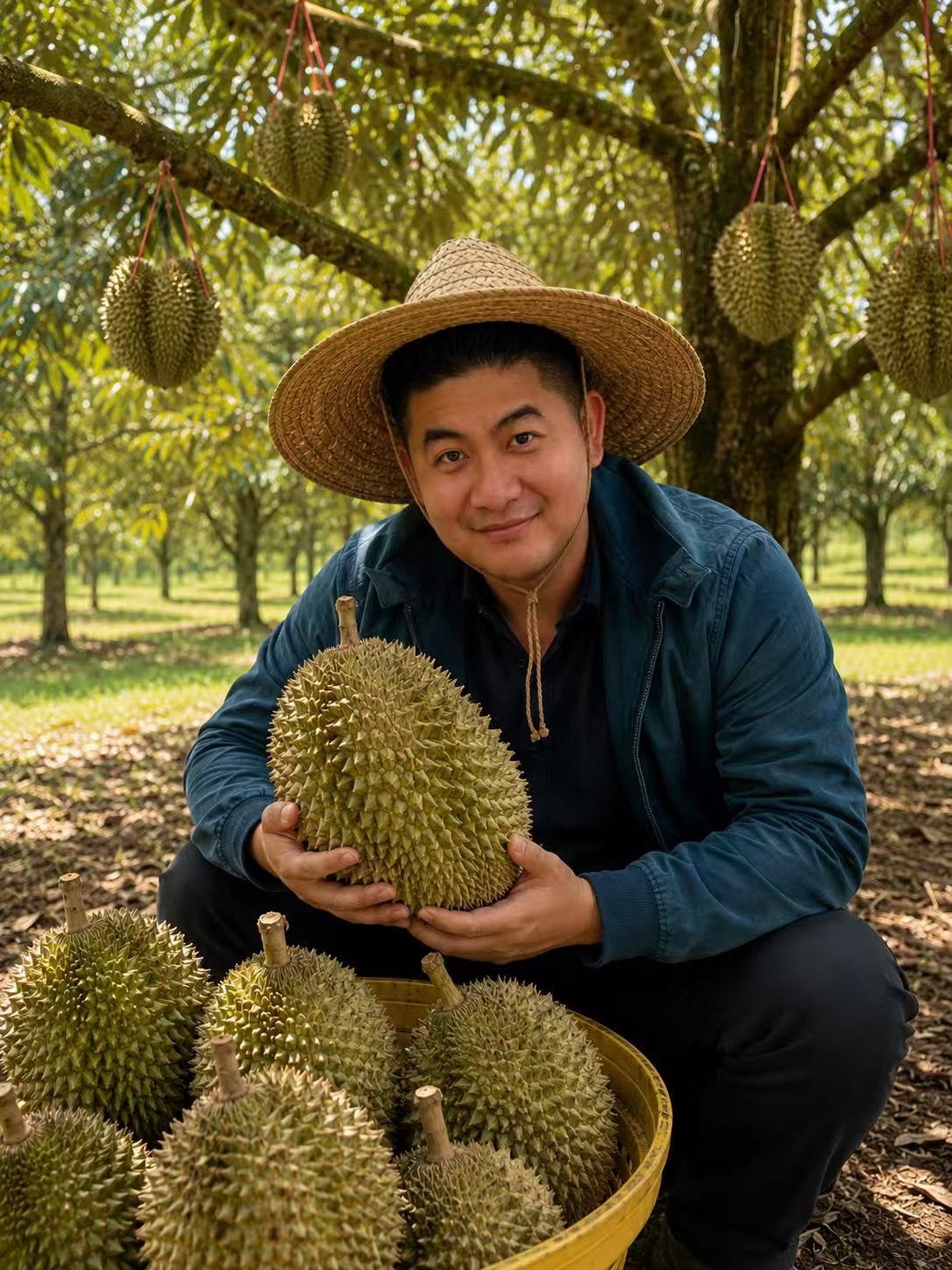
Cambodia has some of the best tropical fruit-growing conditions in the world. Kampot durian, Battambang mango, Mondulkiri avocado — these fruits have loyal followings in local markets, but outside Cambodia, they’re invisible. And Yim Leak has chosen his base: Mondulkiri Province in the country’s northeast. Its red volcanic soil, high elevation, and cool mountain climate are ideal for durian, avocado, and — a secret the world hasn’t yet discovered — coffee.
The problem is twofold.
The growing problem: a technology gap. Cambodian farmers largely rely on traditional methods — no standardized grafting, no scientific irrigation management, no systematic pest control. A Cambodian durian grower produces roughly one-third the yield per hectare of their Thai counterpart.
The selling problem: a market gap. Cambodia lacks cold-chain logistics, grading standards, and export channels. A huge share of fruit spoils after harvest. Inconsistent quality can’t enter international supply chains.
“Thai durian sells for hundreds of yuan apiece in China. Cambodian durian can barely get shelf space in a Phnom Penh supermarket,” Yim Leak says. “It’s not that our fruit tastes worse — try a Kampot durian and tell me it can’t compete with Thailand’s. But we have no brand, no standards, no distribution.”
His solution is straightforward: import Chinese technology, then export the results back to China. It’s early days — the partnerships are still being negotiated — but the direction is set.
Specifically:
·In discussions with several Chinese universities and agricultural research institutes to bring in grafting techniques, integrated water-fertilizer systems, and post-harvest handling standards. No agreements have been signed yet; both sides are working through the technical details and implementation models.
·Plans for a standardized demonstration farm in Mondulkiri — durian, avocado, and coffee — starting at 1000 hectares.
·Regular on-site training visits from Chinese agricultural specialists, once the partnerships are formalized.
·A planned cold-chain logistics hub stretching from Mondulkiri to Phnom Penh to the deep-water port at Sihanoukville.
“Farmers don’t need to understand ‘integrated water-fertilizer systems,’” Yim Leak says. “They need to see their neighbor’s field producing bigger fruit at higher prices after adopting these methods. Then they’ll come asking to learn.”
Technology solves the “grow it well” problem. But “sell it well” is another challenge entirely.
Cambodian agriculture has long been trapped: the domestic market is too small, and international markets feel out of reach. On either side, Thailand and Vietnam — two agricultural export powerhouses — dominate nearly every regional distribution channel. Thai longan and Vietnamese dragon fruit fill Chinese supermarket shelves. Cambodian produce doesn’t have a spot.
Yim Leak’s team has already visited and assessed several of China’s largest fruit importers — companies that supply supermarket chains and fresh-produce e-commerce platforms across the Yangtze River Delta (Shanghai, Hangzhou, Nanjing), and firms that control wholesale and retail distribution across the Pearl River Delta (Guangzhou, Shenzhen, Hong Kong). The goal now is to move from scouting to formal agreements.
The envisioned partnership model: the Cambodian side handles cultivation and primary processing — cleaning, grading, packing. The Chinese side manages import clearance, distribution, and brand marketing. When conditions are right, both parties form a joint venture trading company with shared equity.
“Cambodian avocado.” Yim Leak pauses, as if tasting the words. “When was the last time you saw ‘Cambodian avocado’ in a premium supermarket? Never. But five years from now, consumers will know the difference between a Cambodian avocado and a Mexican one — a tropical variety, softer, sweeter, better suited to Asian tastes.”
“My parents’ generation lived through war and reconstruction,” Yim Leak says. “Their job was to get the country back on its feet. Our generation has a different task. The country is standing — but most of its people haven’t risen with it.”
Of Cambodia’s 17 million people, roughly 60 percent live in rural areas. The average agricultural household earns less than $1,500 a year. For a smallholder durian farmer, a single harvest might bring a few hundred dollars — and a pest outbreak or a washed-out road during rainy season can wipe that to zero.
“When you work in banking, you see loan applications,” Yim Leak says. “But when you go to Kampot, to Battambang, to Mondulkiri — you see people. They’re not data points. They worked the land their whole lives, just like your parents did, and they have nothing to show for it.”
The core target of the agricultural initiative is to raise participating farmers’ incomes by three to five times their current level. The path: raise yields → raise quality → build a brand → enter international markets → sell at a premium.
“Our neighbors in China have a saying: those who get rich first should help others get rich. The logic holds anywhere,” he says. “Cambodia needs capable enterprises to break through first, then bring the road back for everyone else.”
Cambodia has a problem few outsiders notice: deep dependency on Thai brands.
Walk into any supermarket in Phnom Penh. Look at the labels:
·Instant noodles: Mama (Thailand)
·Seasoning sauces: RosDee (Thailand)
·Energy drinks: M-150 (Thailand)
·Dairy products: Dutch Mill (Thailand)
Even Cambodia’s own agricultural output — rice, mango, durian — is routinely bought up by Thai middlemen, repackaged under Thai labels, and sold to the world as “Product of Thailand.”
“Our mangoes go to Thailand, they put them in a new box with a Thai flag on it, and sell them to China at triple the price,” Yim Leak says. “Thailand gets the money. Cambodian farmers get nothing.”
This is about more than money. It’s about national self-respect.
“How much of what Cambodians eat and drink every day carries a Cambodian brand?” Yim Leak writes a single word on his whiteboard: Food. “Food comes first. You don’t talk about clothing brands or housing when people are eating food with somebody else’s name on the package. Let our people eat products that say ‘Cambodia’ on the label. That’s step one.”
The example that frustrates him most: Cambodian rice.
Cambodian jasmine rice has won gold at the World Rice Conference for three consecutive years — 2022, 2023, 2024 — beating Thai jasmine rice to claim the title of “World’s Best Rice.” And yet, have you ever seen “Cambodian Jasmine Rice” on a supermarket shelf outside Southeast Asia? Almost certainly not.
Thai traders buy Cambodian paddy cheap, truck it across the border, mill it, package it, and label it “Thai Jasmine Rice” for export to China, Europe, and America. Consumers eat Cambodian rice and thank a Thai brand.
“We have the best rice in the world, and we don’t even have our own rice brand,” Yim Leak says. “Never mind value-added processing.”
Value-added processing — this is where Cambodia’s rice supply chain is thinnest. Nearly everything Cambodia exports is a primary commodity: paddy, or at best, milled white rice. Meanwhile, across the border, Thailand and Vietnam have built hundreds of derivative products from the same grain: rice wine, rice vinegar, rice noodles, rice crackers, rice bran oil, rice protein powder, baby rice cereal.
“Why can’t Cambodia have its own rice wine?” he asks. “Japanese sake uses Japanese rice. Korean makgeolli uses Korean rice. The whole world knows those. Cambodian jasmine rice has won world gold three times running — tell me why nobody is fermenting a bottle of ‘Cambodian Rice Wine’ from that grain.”
In his plan, food processing is a core pillar:
·Rice wine and rice vinegar: build a fermentation facility using Cambodian jasmine rice, launch a Cambodian rice wine brand
·Rice noodles and rice crackers: Cambodia already eats rice noodles — Num Banh Chok, the traditional Khmer breakfast — but nothing is produced at industrial scale under a national brand
·Fruit processing: freeze-dried Mondulkiri durian, avocado oil, dried mango
“Sell raw materials, you earn a 10 percent margin. Process and export, you earn 100 percent,” Yim Leak says. “We have to stop doing the world’s dumbest business — selling our best things cheap to other people so they can get rich and famous off them.”
In Yim Leak’s vision, the food strategy has three layers:
Layer one: branded primary produce. Mondulkiri Durian. Mondulkiri Avocado. Cambodian Jasmine Rice. These are not commodities — they are place-of-origin products. Like Bordeaux wine, like Yunnan Pu’er tea, the name itself carries value. “Mondulkiri” should be the entry point through which the world discovers Cambodian agriculture.
Layer two: branded processed products. Cambodian rice wine. Freeze-dried Cambodian durian. Cambodian avocado oil. Dried Cambodian mango. Moving from raw material to finished product doubles the margin — and doubles the brand recognition. Consumers don’t need to know what jasmine rice is. They can remember “Cambodian rice wine.”
Layer three: branded everyday essentials. Bottled water, cooking sauces, rice noodle products — the things Cambodians buy every week deserve a Cambodian brand to choose. Bottled water from Cambodia’s mountain springs. Sauces made with local ingredients to local tastes.
And then there is Mondulkiri’s coffee — a distinctive growth opportunity. The elevation and climate of Mondulkiri closely resemble Vietnam’s Central Highlands, the engine room of Vietnamese coffee. Yet Cambodian coffee has virtually no presence in global markets. “Cambodian coffee beans — the concept itself is blank. A blank canvas is an opportunity.”
As for apparel, affordable housing, transport — Yim Leak hasn’t abandoned these ideas, but they sit behind “food” on the priority list.
“Settle the food question first. The durian trees are productive, the brands are established, farmers’ incomes have doubled — then we can talk about clothing and housing,” he says. “What’s the point of wearing your own brand of shirt if everything on your plate has somebody else’s name on it?”
“National confidence doesn’t come from slogans,” he adds. “It comes from starting your day with rice grown in your own country, coffee grown in your own country, cooking sauces made in your own country. You don’t need a flag on your chest. You know where you’re from. That’s the real thing.”
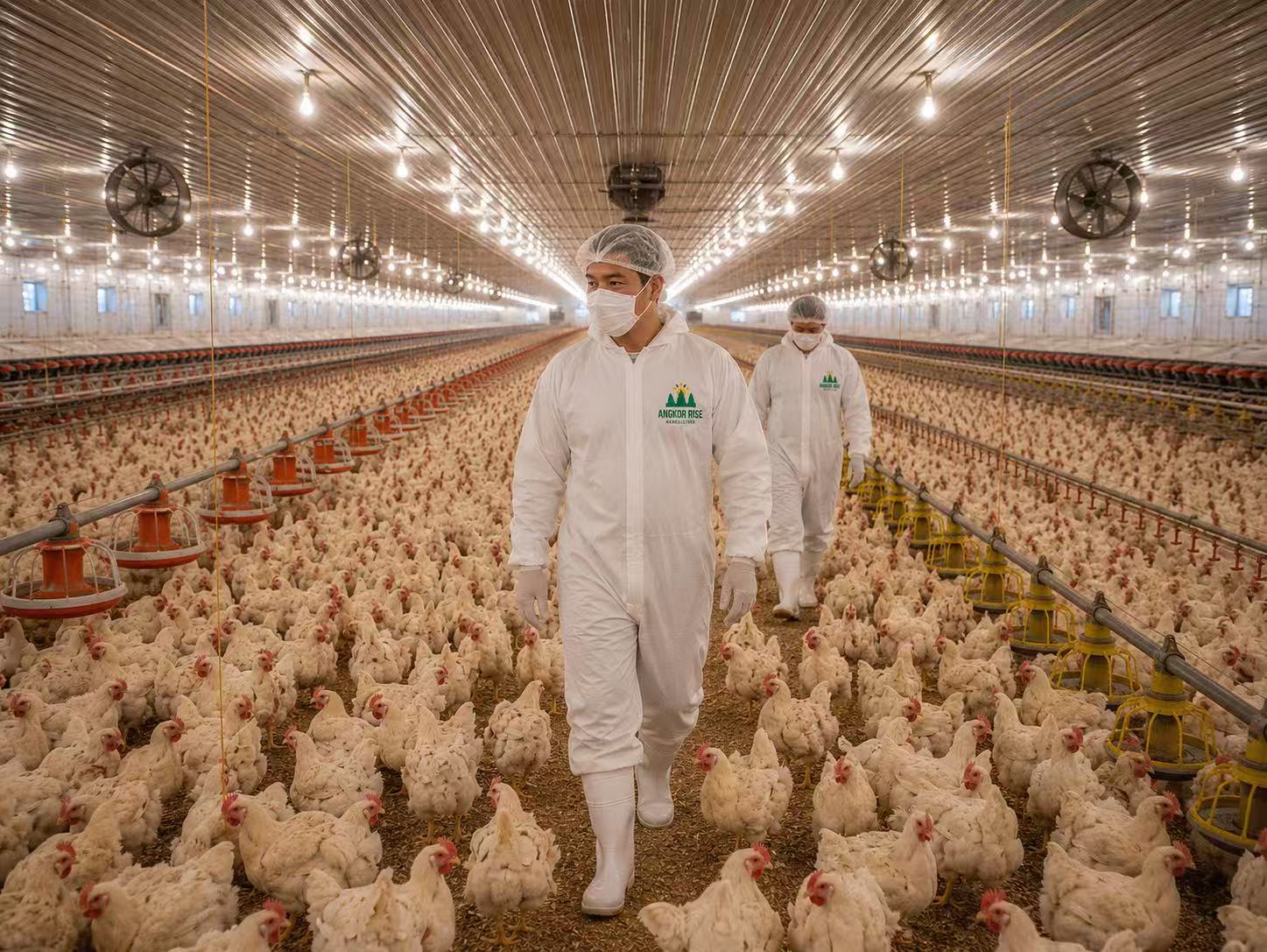
Beyond durian and avocado, Yim Leak is working on something more grounded: poultry and eggs.
Cambodia’s egg market is heavily dependent on imports. Thai eggs dominate supermarket shelves. Local production is small-scale and technically backward — most rural households raise a handful of free-range chickens with low yields and uneven quality. The chicken meat situation is similar: local supply is insufficient, cold-chain infrastructure is patchy, and imported frozen chicken parts flood the market.
“Fruit takes five to seven years to see a return. Poultry and eggs are different — you can see results within a year,” Yim Leak says. “A farmer keeps 500 laying hens. Each hen lays maybe 250 eggs a year. That’s 125,000 eggs. Sell them to a buyer, and the income is far higher than a year of growing rice.”
The model he envisions: the company supplies chicks, feed, and technical guidance. Farmers handle the husbandry. The company buys back eggs and birds at a guaranteed floor price. The target economics: break even in year one, turn a net profit in year two.
“A farmer doesn’t need a bank loan. They don’t need to mortgage their house. They need a chicken coop and two hands willing to work.”
As a business logic, poultry and fruit form a natural complement: fruit is a long-duration asset, poultry is short-cycle cash flow — paired together, a farmer waiting five or six years for durian trees to mature can feed their family on egg income in the meantime.
“One family — durian on the hillside, chickens down below,” he says. “Five years later, the durians are fruiting and the chickens have been through multiple cycles. At that point, they’re not a poor household anymore. They’re running a small, stable enterprise.”
“A durian tree takes five to seven years from planting to harvest,” Yim Leak adds. “Agriculture isn’t finance — you don’t sign a contract today and book a profit tomorrow. Farming requires patience. But if you’re willing to wait, it pays you back.”
The logic of Yim Leak’s agricultural vision holds together: Cambodia has land and labor, China has technology and market access. What’s missing is a pair of hands to connect the two ends.
But the distance between a coherent plan and a successful reality is roughly the length of an entrepreneur’s career. Agriculture demands extraordinary patience, and cross-border agricultural trade — with its supply-chain complexity, quality-control rigor, and brand-building demands — makes banking look straightforward by comparison.
No one knows whether Yim Leak’s agricultural dream will materialize. Including, one suspects, the man himself.
But if it does, it won’t just be a business story.
It will be a story about Cambodian farmers. A story about whether prosperity really can be shared. A story about whether Cambodia can, amid a jungle of other people’s brands, grow one with its own name on it.
This article is a business feature based on an interview with H.E Yim Leak and publicly available information. All business plans and timelines mentioned are internal corporate projections and may be subject to change.
Explore further
| IPC (International Pathway Ce | Tech Empowers Urban Governanc |
| From Virtual to Visionary: Sh | Miura Pharmaceutical Announce |
| 70 Years of Spring Sugar’s | Seventy years of fragrance of |